If you have searched for a marble moorti price online, you have probably seen two moortis that look alike in photos but are priced very differently. That gap is real, and it is not random. As a family workshop in Chandpol Bazar, Jaipur that has carved white marble moortis since 1979, we get asked about price more than anything else. This guide explains, in plain words, what goes into the cost, so you can compare quotes fairly and know what you are paying for.
In short
- Size and the amount of carving are the two biggest drivers of price.
- The quality of white marble matters as much as the carving. Ask which marble is used.
- Painting and gold leaf are hand work and add to the cost, but also to the beauty.
- A fair quote names the size, marble, finish, delivery and timeline in writing before work starts.
1. Size of the moorti
Size is the first thing that moves the price. A bigger moorti needs a bigger, flawless block of marble, more days of carving and more days of polishing. The jump is not linear: a 24 inch moorti uses far more stone than two 12 inch moortis, and a clean block at that size is harder to find.
Most families choose by the space they have:
- 6 to 12 inch for a home mandir shelf or a wooden wall temple.
- 12 to 24 inch for a pooja room or a marble mandir.
- 24 to 48 inch for large pooja halls, farmhouses and offices.
- 4 ft and above for temples, trusts and ashrams.
Measure the height of your niche and leave about a quarter of it free above the crown. If you are between two sizes, the smaller one often looks better and costs less. Our full collection lists the sizes we carve for each moorti.
2. Quality of the marble
Not all white marble is the same. Fine-grain white marble from Rajasthan, including Makrana, takes a smooth polish and keeps its glow for generations. Lower grades can have grey veins, yellow patches or soft spots that show up after a few years of abhishek.
A cheaper price can simply mean a cheaper stone, or even a cast or resin piece sold as marble. When you compare quotes, ask the seller to name the marble and send a clear close-up photo in daylight. At our workshop we carve in white marble, mostly Makrana and other fine-grain white marble from Rajasthan, and we tell you which before you order.
3. Depth of carving and detail
Two Ganesh ji moortis of the same height can take very different amounts of work. Deep carving in the mukut, jewellery, fingers and vastra, open spaces between the arms, and a carved prabhavali behind the deity all add days of careful chisel work by an experienced karigar. Faces, eyes and hands are the slowest part, because a mistake there cannot be undone.
Look closely at photos of the face and jewellery. Crisp, deep detail with smooth finishing is a sign of skilled hand work. Shallow, blurred detail usually means a quicker, cheaper process.
4. The deity and the form
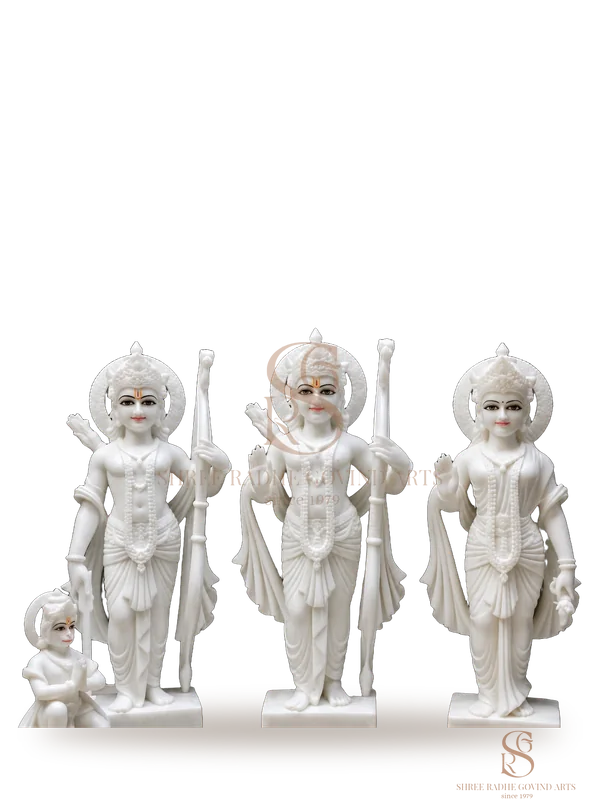
A single seated deity is simpler than a group. A Ram Darbar set or a Shiv Parivar has several figures, vahans and ayudh, all of which must be in correct proportion to each other. An eight-armed Durga Maa on a lion takes more carving than a two-armed standing form.
Forms that follow the shastras also need care: the right mudra, the right vahan, the right number of hands. If your pandit ji has a specific form in mind, share it early so the quote reflects it.
5. Painting and gold work
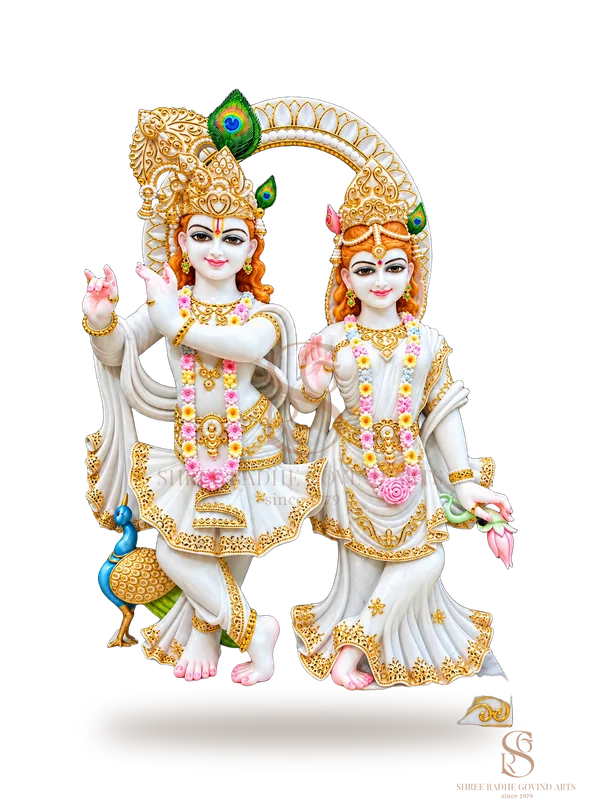
Many families like a pure white moorti with only the eyes and tilak painted. Others want painted vastra, colourful garlands, or real gold leaf on the mukut and jewellery. Each step is done by hand after carving and polishing, so it adds to both time and price.
- White with painted features: eyes, tilak and fine lines painted by hand. The most popular choice.
- Pastel painted: soft colours on the vastra and ornaments, as in our pastel Radha Krishna.
- Gold work: gold leaf on the crown and jewellery, as in our Radha Krishna with gold work.
Want a price for a specific moorti? Send the deity, size and finish on WhatsApp and we reply with real photos and an exact quote the same day.
Get price on WhatsApp6. Single block or joined pieces
Some moortis are made by joining separately carved parts, for example the arms, the base or the prabhavali. Joining is quicker and uses smaller stones, so it can be cheaper. Over time, joints can show lines, collect water during abhishek, or loosen.
We carve every moorti from a single block, with no joints in the deity. It needs a bigger flawless stone and more skill, which is part of the cost, but it is also why a marble moorti can stay in a family mandir for generations. When comparing prices, ask directly: is this one block?
7. Ready piece or custom order
A moorti that is already finished in our showroom can usually ship in 3 to 5 days. A custom moorti, carved to your size, form or photo, usually takes 3 to 6 weeks, and large temple moortis can take longer. Custom work starts with a drawing that you approve, so it involves design time as well as carving.
If you have a festival, griha pravesh or pran pratishtha date, tell us when you ask for a quote. We will tell you honestly whether a custom piece can be ready in time, or suggest a finished piece instead. See how ordering from Jaipur works for the full step-by-step.
8. Packing, delivery and installation
Marble is heavy and the fine parts of a moorti, like fingers and crowns, need protection in transit. We pack every moorti in a wooden crate with foam lining and ship it insured, across India and overseas. Bigger moortis need bigger crates and cost more to transport, especially to another country.
For temples, there may also be platform and installation work. We help temple committees plan this. Make sure any quote you compare says clearly whether packing, insurance and delivery are included, so there are no surprises later.
How to get an accurate quote
The fastest way to an exact price is to share four things:
- The deity and form you want, with a reference photo if you have one.
- The size, or the height of your mandir niche.
- The finish: white with painted features, pastel painted, or gold work.
- Your city or country, and the date you need it by.
Send these on WhatsApp and we reply with photos of similar finished pieces and one clear price. If you are in Jaipur, you are welcome to see finished moortis at our two shops in Chandpol Bazar, open every day from 10 am to 8 pm.
Questions families ask
What is the price of a marble moorti?
It depends on the size, the quality of marble, how much carving and detail the form has, and the finish. A small moorti with painted features costs far less than a large temple moorti with gold work. Share the deity, size and finish on WhatsApp and we send an exact price with photos the same day.
Why are some marble moortis online so cheap?
Usually because of a lower grade of marble, shallow machine-assisted carving, joined pieces instead of a single block, or a material that is not marble at all. Ask the seller to name the marble and send a close-up of the face in daylight before you compare prices.
Does gold work increase the price of a moorti?
Yes. Gold leaf is applied by hand on the crown and jewellery after carving and polishing, so it adds both time and material cost. Many families choose white with painted features and add gold work only on the main moorti of the mandir.
Is delivery included in the price?
We give one clear quote before work starts, and it says what is included. Every moorti is packed in a wooden crate with foam lining and shipped insured, in India and abroad. Delivery cost depends on the size of the crate and the destination.
Can I see the moorti before I pay the full amount?
Yes. For custom orders you approve a drawing before carving starts, and we send photos on WhatsApp at every stage, from rough cut to final painting.
Looking for a moorti?
Tell us the deity and size. We share photos and an exact price the same day.